LLM Watch
Jan 28, 2026
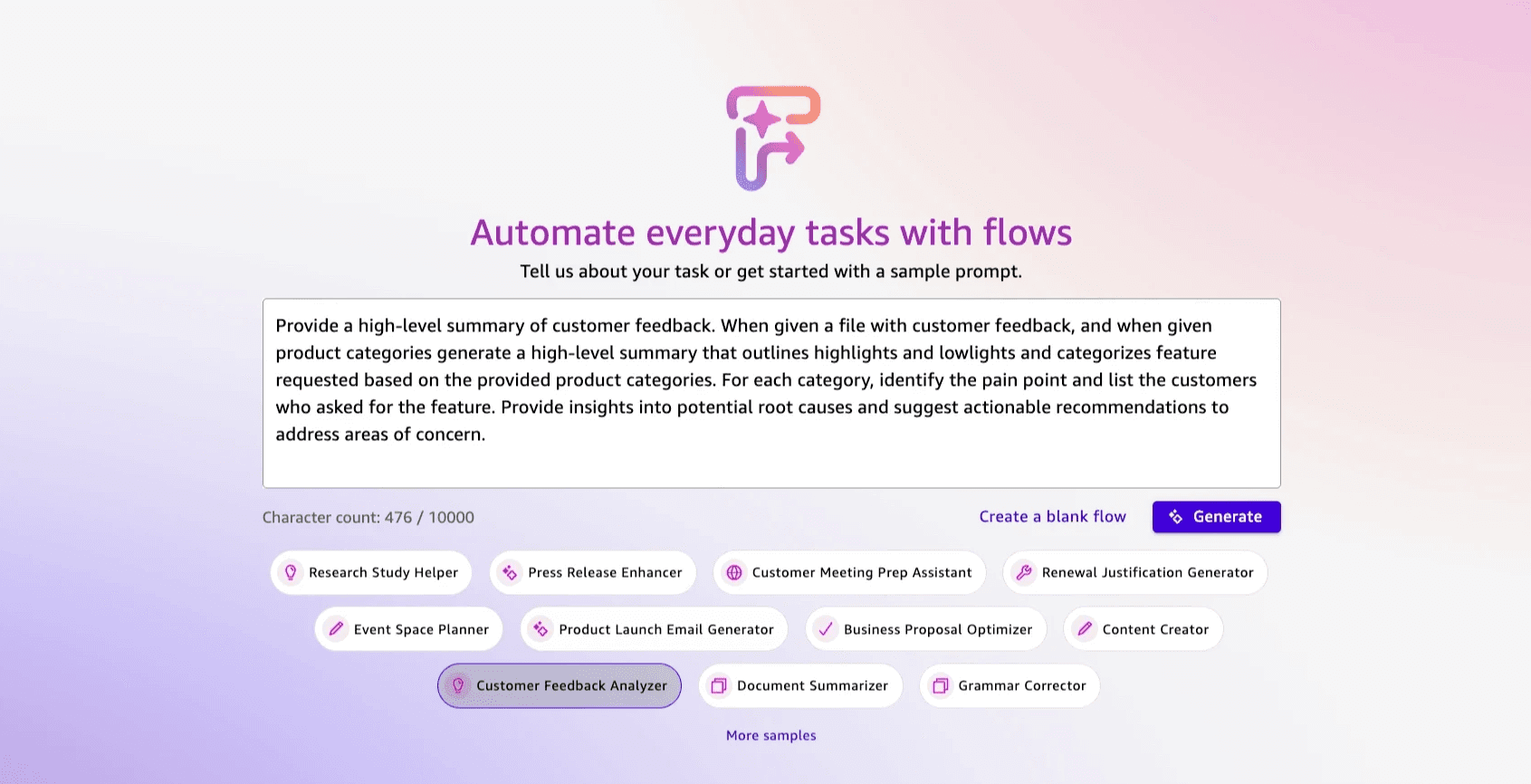
Amazon’s Quick Suite brings AI agents into everyday work, transforming scattered tools into one intelligent workspace built for the future of work. Photo Credit: AWS
Amazon Quick Suite centralizes your files, data, and workflows, then uses AI agents to search, analyze, and act across them so you spend less time organizing and more time deciding.
The suite’s modules — Quick Index, Quick Research, Quick Sight, and Quick Automate — turn natural-language requests into knowledge retrieval, analysis, dashboards, and running automations without code.
By unifying tools and context, Quick Suite shifts work from reactive tab-hopping to proactive execution, surfacing insights, simulating scenarios, and kicking off next steps before you ask.
Teams gain cognitive relief and speed, moving routine reporting and coordination to agents while focusing human effort on judgment, creativity, and stakeholder work.
This marks a broader move to agentic work, where smaller, more fluid teams orchestrate AI collaborators, adopt continuous learning, and measure outcomes by impact rather than app usage.
If your computer looks anything like mine, your browser has at least 47 tabs open, a few pinned “for later,” others halfway through a spreadsheet, a couple of Slack threads you swear you’ll get back to. Then there’s the internal dashboard, the email app, a PDF buried somewhere on your desktop, and five windows you opened to remind yourself to organize the other windows.
And somehow, half of your workday is spent organizing your work.
So when I saw Amazon Web Services (AWS) announcing a new platform called Quick Suite, I did what we all do: opened yet another tab. But this one might actually close a few.
Quick Suite isn’t another productivity tool. It’s AWS’s biggest step yet into agentic AI, a system where AI agents collaborate with you across every part of your digital workspace.
At its core, Amazon Quick Suite is a unified, AI-driven workspace designed to integrate all your data, documents, and workflows into one place, then give you intelligent agents that can search, analyze, reason, and act across it [1].
If that sounds abstract, think of it this way: instead of you switching between 12 apps to complete one project, Quick Suite’s agents bring those apps together and handle much of the coordination automatically.
Under the hood, it’s powered by Amazon’s own large language models (LLMs) and orchestration framework, the same infrastructure behind Bedrock and Q Business, meaning it can understand natural language, connect to enterprise data, and perform multi-step reasoning [3].
Each module within Quick Suite, Quick Index, Quick Research, Quick Sight, and Quick Automate, plays a role in cutting through organizational clutter:
Quick Index connects to your company’s data sources and builds a live, searchable knowledge base that understands meaning, not just file names.
Quick Research acts like an autonomous analyst, planning and completing research tasks with citations and summaries.
Quick Sight brings natural-language analytics, so asking “What did Q3 revenue look like by region?” produces a chart instantly.
Quick Automate converts a plain English description, like “Summarize daily support tickets and email the team every Friday”, into a running automation, no code required.
These features run atop AWS’s secure infrastructure with full identity and access controls, so each AI agent can be monitored, audited, and governed like a digital employee [3].
Quick Suite isn’t just another productivity tool; it’s a structural change in how digital work happens. Here’s what that means in practice.
Most of today’s work happens across too many disconnected tools. Files live in one app, data in another, and conversations somewhere else. Quick Suite brings everything together in a single workspace where information flows naturally and context is always within reach. Every file, dataset, and update connects, so your work starts from clarity instead of chaos.
Instead of spending time hunting for tabs, tracking versions, or piecing together what happened yesterday, you begin each task with what you need already in front of you. Quick Suite’s AI agents surface the right materials at the right time—the presentation before your meeting, the latest numbers when you open a report, or the key discussion points before you write a reply.
The result is a smoother, more focused way to work: less time managing tools, more time making progress.
Most digital tools wait for you to act. Agentic systems, like Amazon’s Quick Suite, anticipate your needs before you even articulate them. Quick Suite’s AI doesn’t just react; it continuously learns from your interactions, monitors project rhythms, and predicts what information or actions you’ll need next. It observes recurring meeting times, workflow bottlenecks, and collaboration patterns—then intervenes intelligently. It might prepare status briefs the night before a review, flag anomalies in data before they escalate, or even recommend automations when it notices repetitive manual work.
Each agent works in concert with others, sharing context across Quick Index, Quick Research, and Quick Automate so insights flow seamlessly between discovery, analysis, and execution. In essence, Quick Suite evolves from a passive assistant to an active collaborator, shifting work from “tell me what to do” to “I’ve already handled it,” redefining productivity as foresight rather than reaction.
These agents don’t just follow instructions, they interpret, reason, and decide within defined boundaries. Instead of managing every click or step, you simply describe the outcome you want, and the agent charts the path to get there. They operate more like thoughtful collaborators than obedient tools, adapting to context and making judgment calls within safe parameters.
The goal isn’t to replace people, but to elevate what humans do best, critical thinking, creativity, empathy, and connection. By taking on repetitive execution, these agents give teams the freedom to focus on judgment, innovation, and relationship-building, the uniquely human dimensions of work that drive value, trust, and growth.
Our mental load at work comes less from the difficulty of tasks and more from the constant fragmentation that defines the modern workspace. Every day, we juggle countless platforms—Slack, Sheets, dashboards, inboxes—each demanding a slice of our attention and memory. We waste energy not on thinking, but on reconstructing the context we already had yesterday: where files are stored, which version is current, what was said in the last meeting.
By centralizing memory and reasoning, Quick Suite dissolves that friction. It creates a single cognitive thread across your work—one that remembers what you were doing, why it mattered, and what comes next. Instead of mentally reloading your workspace every morning, Quick Suite lets you pick up right where you left off. The result isn’t just efficiency; it’s mental clarity. The platform quietly returns your focus to problem-solving, creativity, and decision-making.
It’s an invisible productivity gain—not about typing faster or automating more steps, but about thinking better.
The biggest cultural shift here is psychological. For the first time, AI isn’t an add-on; it’s a co-participant in the flow of work. Instead of being a feature you access, AI becomes the connective tissue of your entire workspace, the invisible layer linking tools, data, and decisions in real time. That redefines not only how we work, but what we value at work.
It asks for new kinds of literacy: knowing how to shape prompts as clearly as you’d give instructions to a teammate, maintaining oversight of AI-driven decisions, and developing ethical awareness around data use and automation. But it also invites creativity. As AI moves from peripheral tool to central collaborator, it creates space for emerging roles such as workflow designers who architect how humans and agents cooperate, AI auditors who ensure transparency and fairness, and collaboration architects who design systems where human judgment and machine intelligence reinforce each other.
The rise of systems like Quick Suite signals something bigger: the age of agentic work.
In the first wave of AI, we had pattern recognition, algorithms that could see, predict, or generate text. The second wave brought automation, systems that followed rules to speed up repetitive tasks.
Quick Suite represents the third wave: adaptive agents that combine reasoning, memory, and action.
That shift will likely redefine organizational structure in three ways:
Smaller, smarter teams: With AI handling administrative and analytical work, teams can stay lean and focus on creative and strategic tasks.
Fluid roles: Job descriptions may become modular, centered around goals rather than functions. Employees will orchestrate agents as part of their team.
Continuous learning ecosystems: As agents learn from human feedback, workplaces will evolve dynamically, changing not just what people do, but how knowledge flows.
The practical implication? Time and attention, the scarcest resources in the modern office — could finally be reclaimed.
We’ve spent two decades adding tools to make work easier, and somehow ended up with more work. Amazon’s Quick Suite feels like a course correction, a chance to make AI the glue that holds work together, instead of another window to manage.
If it delivers, we might spend less time curating our own chaos, and more time doing the parts of work that matter.
For once, the promise of “working smarter” might not be a metaphor.
Amazon Web Services, “Reimagine the Way You Work with AI Agents in Amazon Quick Suite,” AWS Blog, Oct. 2025. https://aws.amazon.com/blogs/aws/reimagine-the-way-you-work-with-ai-agents-in-amazon-quick-suite/
Amazon Web Services, “Amazon Quick Suite Overview,” AWS, Oct. 2025. https://aws.amazon.com/quicksuite/
Amazon Web Services, “Amazon Quick Suite — Agentic AI-Powered Workspace,” AWS News Blog, Oct. 2025. https://aws.amazon.com/about-aws/whats-new/2025/10/amazon-quick-suite-agentic-ai-powered-workspace/