AI SEO & Discoverability
Jan 4, 2026
Google has shifted from traffic director to answer engine — AI Overviews now synthesize information directly on search results pages using Generative Engine Optimization (GEO), often satisfying user intent before they scroll to traditional organic listings.
Ranking #1 no longer guarantees visibility — A "citation gap" exists where top-ranking pages are absent from AI Overviews that appear above them, creating a binary visibility outcome: you're either cited in the AI-generated answer or invisible beneath the fold.
High-value informational queries are most vulnerable — Complex comparisons, how-to guides, and multi-step questions trigger AI Overviews that intercept top-of-funnel discovery traffic, while navigational and branded searches remain relatively safe.
Success metrics must evolve beyond traffic volume — The new framework measures "seen, cited, and chosen" rather than "ranked and clicked," with focus shifting to AI Share of Voice and qualified conversion rates from link card clicks instead of raw session counts.
Technical structure and unique value are essential for citations — LLMs prioritize content with Schema markup, clear heading hierarchies, direct answers following questions, and "information gain" through original research or expert perspectives that demonstrate E-E-A-T signals.
Executive SummaryFor growth and marketing leaders, Google has fundamentally shifted from a directory that directs traffic to an answer engine that synthesizes information directly on the SERP. This evolution means you can no longer rely on traditional rankings alone; you must optimize to be "seen, cited, and chosen" within AI-generated summaries via Generative Engine Optimization (GEO). This guide explains the mechanics of AI Overviews, the new signals that matter for visibility, and a practical playbook to ensure your content survives the transition to zero-click search.
Basis of Analysis This guide synthesizes documentation from Google Search Central, field observations from our internal LLM Watch monitoring, and cross-platform citation data. Findings on query triggers and ranking displacements are based on current Gemini model behaviors in US English search results.
Google has evolved from a traffic director to an answer engine, creating a new layer of friction between your brand and your audience. Instead of presenting a list of links for you to explore, the search engine now synthesizes information directly on the results page. Today, the search experience is no longer about finding a source; it is about finding an answer immediately. This transition forces marketers to abandon the "ten blue links" mentality and accept that the search results page itself has become the destination.
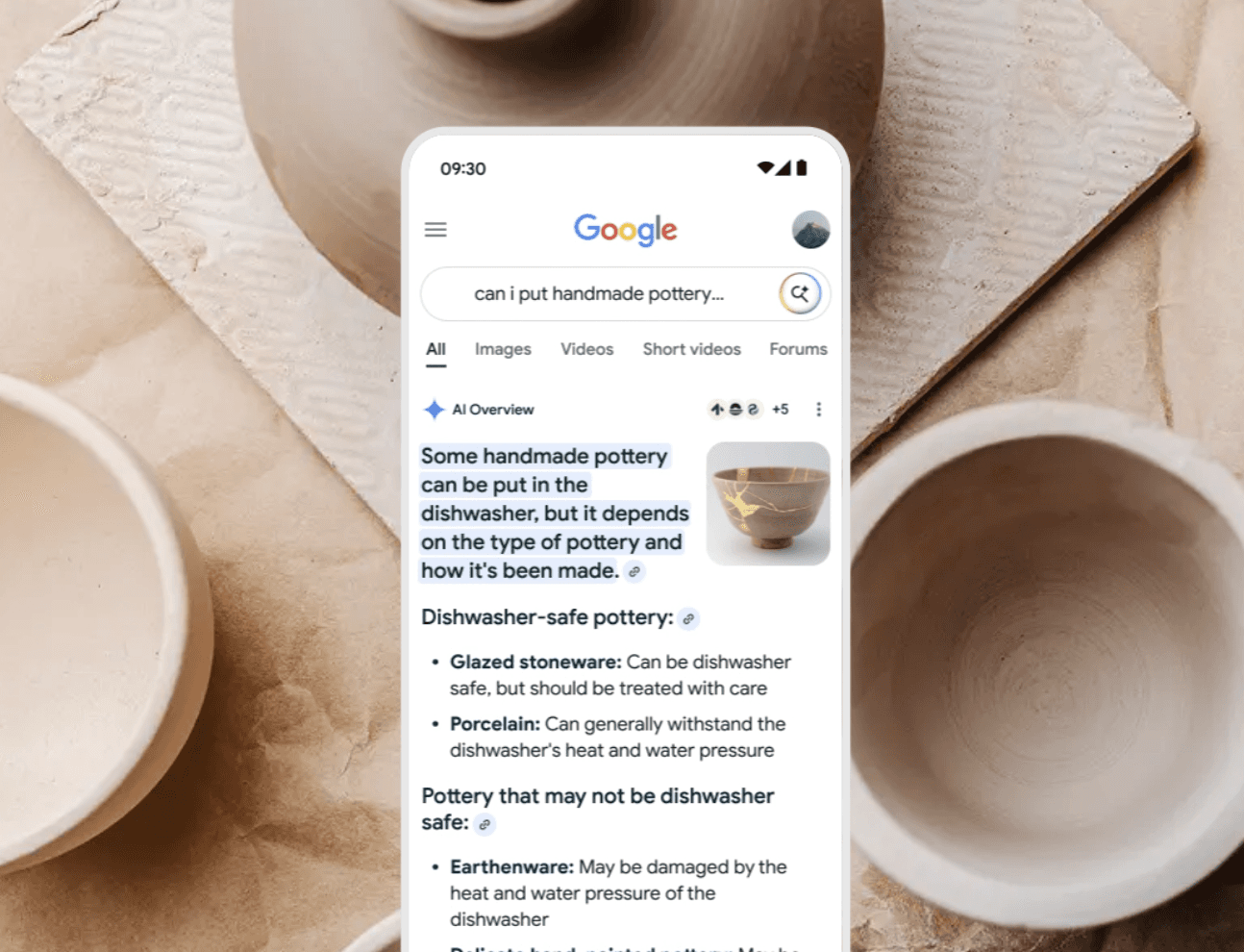
AI Overviews are generative layers built on Gemini models that synthesize real-time answers from the search index and Knowledge Graph. Unlike static snippets that scraped single paragraphs, this process uses Retrieval-Augmented Generation (RAG) to read multiple sources and generate a new response. This synthesis happens in milliseconds, pulling data from various high-authority domains to construct a comprehensive answer.
These summaries appear above organic listings, often pushing traditional "blue links" below the fold and rewriting the user's first impression. The real estate on the Search Engine Results Page (SERP) has changed dramatically; the AI Overview now occupies the "pixel prime time" once reserved for paid ads and the first organic result. For mobile users, this often means the entire initial viewport is consumed by the AI's synthesis.
Old strategies like defining terms in 40 words are insufficient because AI Overviews synthesize narratives rather than extracting quotes. In the past, winning a featured snippet meant answering a question concisely. In the AI era, Google looks for consensus and depth, aggregating facts from multiple sites to create a composite answer.
This shifts the measure of success from "ranked and clicked" to "seen, cited, and chosen." We must ask if GEO is the new SEO as we pivot operations. While SEO focused on keywords and backlinks, GEO focuses on information gain, answer structure, and entity authority. Brands that fail to make this pivot risk managing a declining asset while competitors capture the new generative layer.
A top organic rank is no longer a safety net because AI Overviews now intercept the user intent before they ever scroll to the organic results. In an AI-first world, visibility is binary: you are either a cited source in the answer or you are invisible beneath the fold. The presence of an AI Overview acts as a gatekeeper. If your content lacks the keys to unlock entry into that overview, traditional SEO efforts yield diminishing returns.
The distinction between ranking and citation is defined by the critical difference between holding a position and being part of the answer. We frequently observe a disconnect where a website holds the top organic position for a high-volume query yet fails to appear in the Gemini-generated overview above it. This occurs because the algorithms governing the core ranking system and the algorithms powering the generative layer weigh signals differently.
You may experience a "citation gap," where your brand holds organic position #1 but is completely absent from the AI Overview that users see first. This gap represents lost revenue and brand awareness. The generative model prioritizes content that is factually dense and structurally simple. Bridging this gap requires optimizing for the specific retrieval preferences of Large Language Models (LLMs).
Structure your content for summarization to win the "link card," which is now the primary click opportunity in an AI Overview. The "link card" is the prominent citation bubble or thumbnail that appears alongside or within the AI-generated text. These cards function as the new verified sources of truth. Users who want to verify the AI's answer or dive deeper will click these cards, bypassing the organic results entirely.
If you fail to optimize for this summary layer, you risk traffic erosion even if your traditional rank tracking tools show stable positions. Many marketing teams currently see a confusing trend: rank trackers report steady positions, yet analytics show a decline in organic sessions. This "invisible" loss is attributed to the AI Overview satisfying the user's intent immediately.
High-value informational queries—complex comparisons, "how-to" guides, and multi-step questions—are the primary triggers for AI layers. These searches drive brand awareness and are most likely to be intercepted by AI Overviews. Google aims to use AI where it adds the most value, which typically involves synthesizing disparate information rather than simply retrieving a URL.
Complex "how-to" questions and comparisons frequently trigger an AI Overview today. Queries such as "best software for small business" or "how to fix a leaky faucet" often result in a generative summary. The AI excels at aggregating pros and cons or step-by-step instructions, saving the user from bouncing back and forth between multiple tabs ("pogo-sticking").
Simple navigational queries remain largely unaffected, preserving some traditional traffic patterns. If a user searches for a specific login page or brand home page, Google understands the intent is navigational and typically suppresses the generative layer. This means that branded search volume remains relatively safe, but top-of-funnel discovery traffic is heavily impacted.
Segment your keyword lists into "AI-prone" (informational/commercial investigation) vs. "standard search" (transactional/navigational). This segmentation allows you to allocate resources effectively. "AI-prone" keywords require a GEO strategy focused on answer structure and citations. "Standard search" keywords can still rely on traditional SEO tactics.
Be aware that high-intent, lower-funnel queries are increasingly intercepted by AI summaries that offer direct product comparisons. A user searching for "CRM platform pricing comparisons" is now presented with a table generated by AI. If your product is not included in that table due to unstructured content, you lose the prospect before they visit your site.
Zero-click searches represent a fundamental shift where brand authority is established directly on the SERP rather than on your landing page. When a user gets their answer without leaving Google, the battle for influence moves from your landing page to the search result itself. In this environment, your content must do the selling within the search result, acting as a billboard rather than just a doorway.
View the zero-click interaction as a shift toward establishing authority immediately within the search interface. The rise of zero‑click searches creates a powerful branding signal when you appear in the summary. If Google's AI trusts your data enough to present it as the answer, the user implicitly trusts your brand.
You must accept that being the cited source establishes trust even without a click. If an AI Overview cites your brand for a key statistic, the user absorbs that data and attributes authority to you. This is a top-of-funnel win that contributes to "mental availability" even if it doesn't immediately register as a session in analytics.
Visitors who click link cards are highly qualified because the AI summary has already filtered out low-intent users. While raw session volume may drop for informational queries, the users who do click through are often lower in the funnel. They are looking for deep dives, verification, or specific nuances that the summary could not provide.
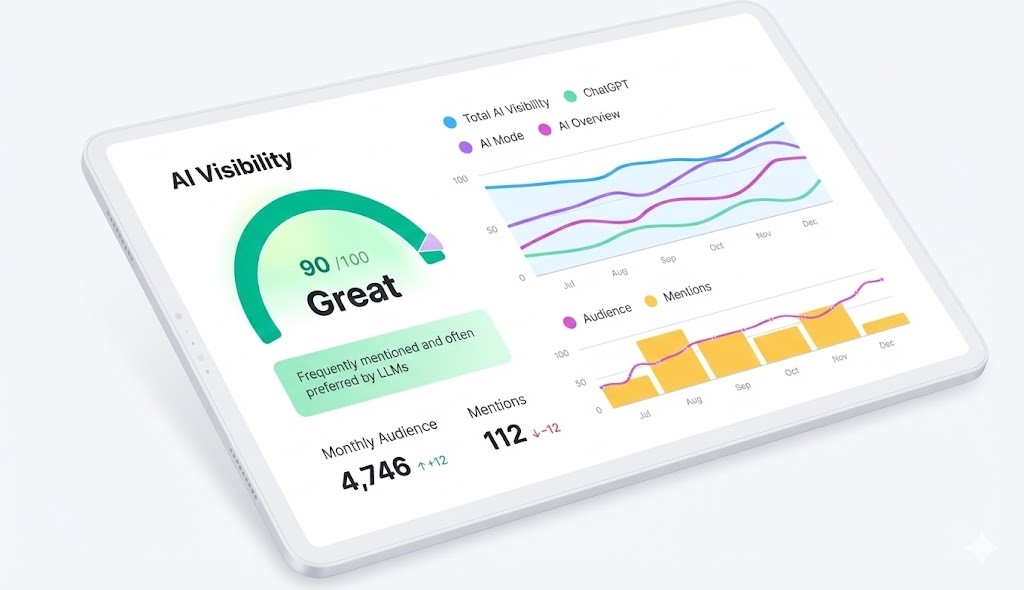
Shift your KPIs from raw traffic volume to "AI Share of Voice" and downstream conversion rates. Measuring success by traffic volume alone is a recipe for panic. Instead, look at the conversion rate of the traffic that arrives. You will likely find that while you receive fewer visitors, the value per visitor has increased because the AI has effectively qualified them for you.
Google’s AI favors content that is structured for machines, authoritative by reputation, and distinct in its value. To be cited, you must make it easy for the model to parse and trust your information. The LLM is a hungry reader, but it is also a lazy one; it prefers content that reduces its computational load.
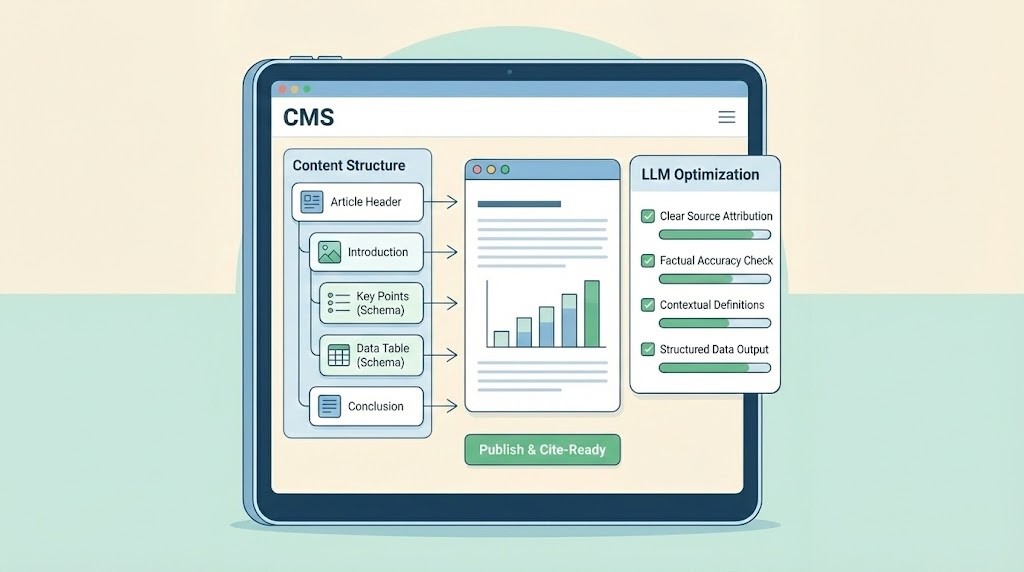
Adhere to technical non-negotiables: robust Schema markup, clear heading hierarchies, and fast load times. Schema markup (specifically Article, FAQ, and Product schema) provides the LLM with a roadmap of your content. It explicitly tells the machine, "This is the question, and this is the answer." Without this, the model has to guess, decreasing the likelihood of citation.
LLMs prioritize content that is easy to parse; ensure clear answers immediately follow questions in your H2s or H3s. Adopt the "BLUF" (Bottom Line Up Front) writing style. If your header asks a question, the very next sentence should answer it directly. Clear, direct syntax helps the model extract facts with high confidence.
Provide "information gain"—unique data, original research, or distinct perspectives that an LLM cannot find on other sites. If your content simply regurgitates what is already on Wikipedia, the AI has no reason to cite you. It can generate that generic information on its own. You must offer something net-new to the knowledge base.
Ensure your content demonstrates Experience, Expertise, Authoritativeness, and Trustworthiness (E-E-A-T), as these are critical filters for inclusion in training and retrieval sets. Google uses these signals to prevent hallucinations and misinformation. Content written by verifiable experts and hosted on authoritative domains is significantly more likely to be selected as a source.
Adapting to AI Overviews requires a shift from keyword stuffing to answer structuring. You need a continuous visibility audit to ensure your content remains citable as models evolve. The following steps outline a pragmatic approach to reclaiming visibility.
Start by manually testing your top 20 traffic-driving informational keywords to see if AI Overviews are appearing and whether your brand is cited. Perform these searches in an incognito window to minimize personalization bias. Note which queries trigger an overview and what format the answer takes.
Identify "content atomicization" opportunities by breaking long-form generic content into specific, answer-focused blocks. If you have a comprehensive guide, ensure it is divided into distinct sections that can stand alone as answers. An AI Overview might only need one specific statistic or definition; make it easy for the model to grab that "atom" of content.
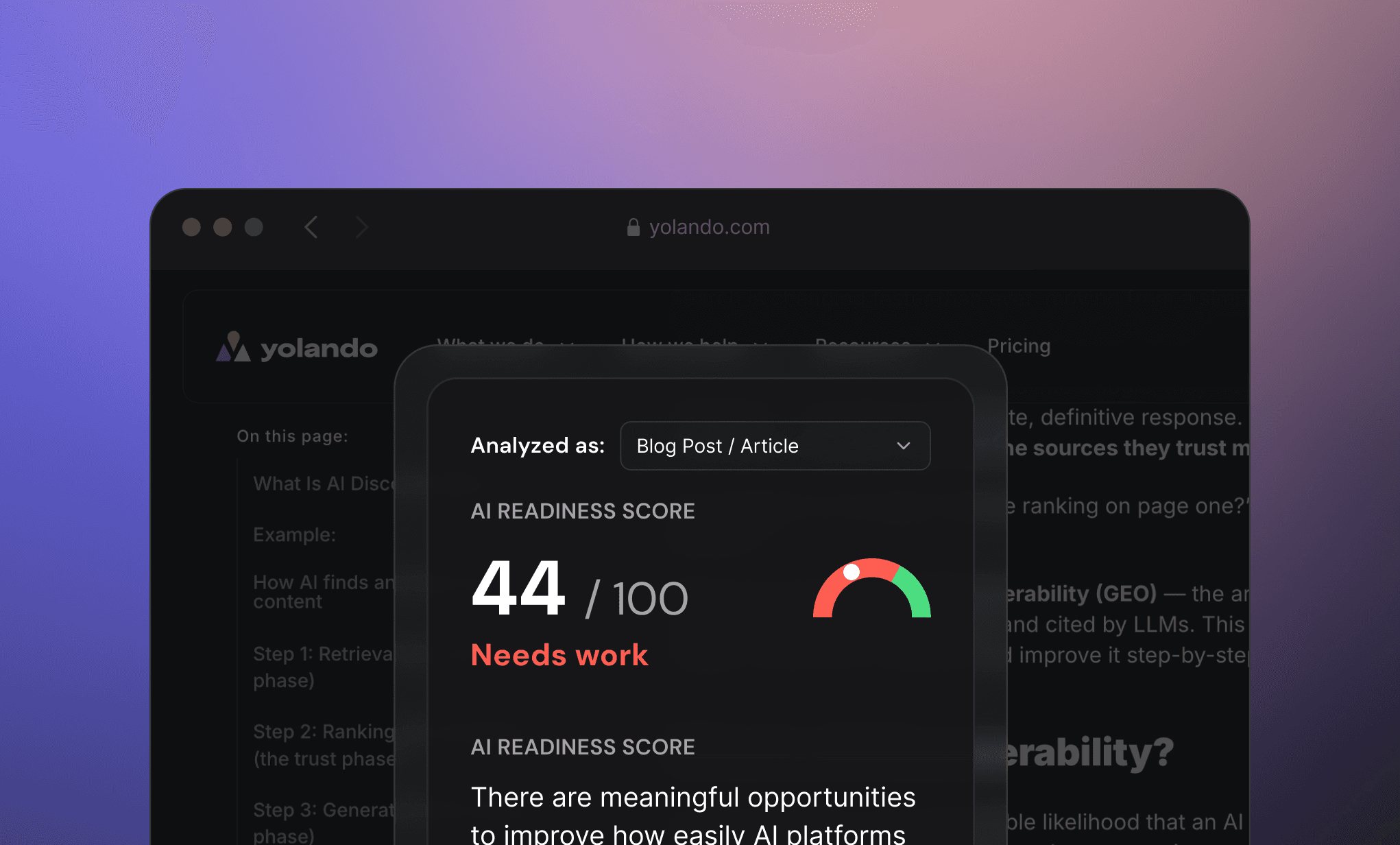
Implement AI visibility platforms to measure your brand's presence in Gemini and AI Overviews. Traditional rank trackers are blind to the content of AI answers. Specialized tools like Yolando allow you to see exactly what the AI is saying about your brand and how often you appear in the crucial link cards.
Understanding how AI visibility platforms shape brand perception is critical for modern measurement. Use these metrics to run "before and after" tests on content structure updates. By monitoring your "share of model," you can react quickly when you drop out of an answer and adjust your content structure to regain that citation.
Review the following criteria to ensure your content is optimized for the generative era and poised to capture citations.
Category | Action Item | Success Metric |
Structure | Implement FAQ Schema and direct answer formatting | Validated Schema / H2 clarity |
Authority | Audit E-E-A-T signals (author bios, citations) | Inclusion in Knowledge Graph |
Uniqueness | Add original data or expert quotes to generic posts | "Information Gain" score |
Measurement | Set up AI Share of Voice tracking | Citation frequency % |
Maintenance | Refresh statistics and dates quarterly | Content freshness signal |
Don’t just follow the AI revolution—lead it. Subscribe to PromptWire for the latest GEO playbooks and LLM Watch updates.