
AI SEO & Discoverability
Jan 4, 2026
Photo Credit: Freepix
Fragmented AI tool stacks don’t share context, so brand voice and approved messaging get re-invented (and drift) with every new prompt.
The result is operational drag: more copy/paste, more rewrites, more approvals—often cancelling out the speed AI promised.
The risk isn’t just tone; it’s message drift and compliance issues when outdated or unapproved claims slip into market-facing content.
The fix is a single, LLM-readable source of truth (brand memory) plus a centralized creation hub that keeps voice + facts consistent across channels.
Marketing teams didn’t adopt AI to create more chaos. But that’s what’s quietly happening in a lot of organizations: the more AI tools you add, the harder it gets to keep your brand voice consistent.
In practice, many teams now run content through a patchwork of models—one tool for ideation, another for drafting, another inside the CMS, another for email copy, another for social. Each tool is “smart,” but none of them share context with each other. They don’t carry your voice forward. They don’t remember what you approved last week. They don’t know which claims are off-limits. So your brand becomes the thing that’s forced to do the connecting—usually through extra editing time, more approvals, and last-minute rewrites.
This is what a fragmented LLM stack creates: fragmented brand output.
Here’s the core issue: most AI tools are designed as standalone assistants, not as systems. They generate text well, but they don’t come with a durable, shared “brand memory.” Without that memory, every new prompt becomes a fresh guessing game.
Your team might have a style guide, a messaging doc, a positioning statement, and product one-pagers—but your AI tools don’t automatically know any of it. If you want them to, you have to paste those materials into prompts or build custom instructions again and again.
Over time, that friction leads to shortcuts:
Teams stop pasting the full guidelines every time.
They assume “the model will figure it out.”
They edit outputs quickly and move on.
That’s how voice drift starts.
Even when teams do provide prompts, they’re rarely identical across tools or teammates. One person feeds tone guidance. Another doesn’t. One tool gets a long brand brief. Another only gets a sentence.
So the tools improvise.
One model defaults to corporate-formal. Another writes like a startup founder on LinkedIn. A third produces “polished” language that sounds safe—but also generic. Individually, each piece might look fine. Collectively, they add up to a brand voice that feels inconsistent, and worse, interchangeable.
A fragmented tool stack often increases work downstream:
copying and pasting brand context across tools,
repeatedly explaining product details and positioning,
rewriting content to match voice,
chasing approvals because each channel “sounds different.”
Ironically, teams can end up spending as much time fixing AI outputs as they would have spent writing from scratch—especially for high-stakes assets like landing pages, customer emails, and executive POV pieces.
The more tools and handoffs you add, the easier it becomes for something outdated or unapproved to slip through: an old tagline, a deprecated feature, an exaggerated claim, a mismatched tone for a sensitive moment. And once inconsistent messaging hits the market, customers notice—even if they can’t describe exactly why.
As Magid puts it, as teams lean on AI to accelerate production, maintaining consistency across channels and creators becomes “mission-critical,” because “one wrong turn, and your brand voice slips.” [1]
When a brand’s voice fractures, the damage rarely shows up as one big failure. It shows up as a slow erosion—small inconsistencies that accumulate until your messaging stops feeling like you.
Customers develop a feel for your voice the way they recognize a person’s tone. If your website feels confident and expert, but your email copy suddenly sounds overly hypey—or your social captions read like a different company entirely—trust takes a hit.
That’s why voice consistency isn’t aesthetic. It’s a trust mechanism. And the more AI you use without shared guardrails, the more likely you are to introduce subtle voice drift at scale. Magid’s framing is blunt and practical: the risk rises as volume rises. [1]
Voice is only half of it. The bigger danger is message drift—where product details, claims, or differentiators shift slightly across channels.
This happens when:
one AI tool pulls a description from an outdated page,
another tool assumes capabilities you could have,
another writes a comparison you’d never approve.
Even without obvious hallucinations, “close enough” language can be damaging:
a claim that sounds stronger than what you can substantiate,
a feature framed as available everywhere when it’s region-specific,
a positioning statement that contradicts your sales narrative.
For marketers, message drift is the kind of risk that triggers brand headaches, sales friction, and in regulated categories, real compliance exposure.
Once brand inconsistency spreads across channels, fixing it becomes harder, not easier. Teams start spending time cleaning up downstream: rewriting assets, retraining freelancers, re-briefing agencies, and updating tool instructions. Worse, customers encounter mixed signals over time, which chips away at brand familiarity—the very thing marketing is supposed to build.
The way out of fragmentation isn’t “use fewer AI tools” (most teams won’t). The way out is creating a single source of truth that LLMs can actually use—a LLM-readable brand memory that grounds every output in the same voice, facts, and approved messaging.
This is the approach tools like Yolando are designed around.
At its core, Yolando continuously learns what makes you uniquely you, your brand voice, existing content, customers, competitors, and industry, and builds a living, breathing model that powers the entire platform. [2] It’s a living system designed to stay current as your business evolves.
“LLM-readable” isn’t a technical flex—it’s a practical one. It means your brand knowledge is organized in a structured way AI can reliably pull from, rather than forcing the model to infer your identity from vague prompts.
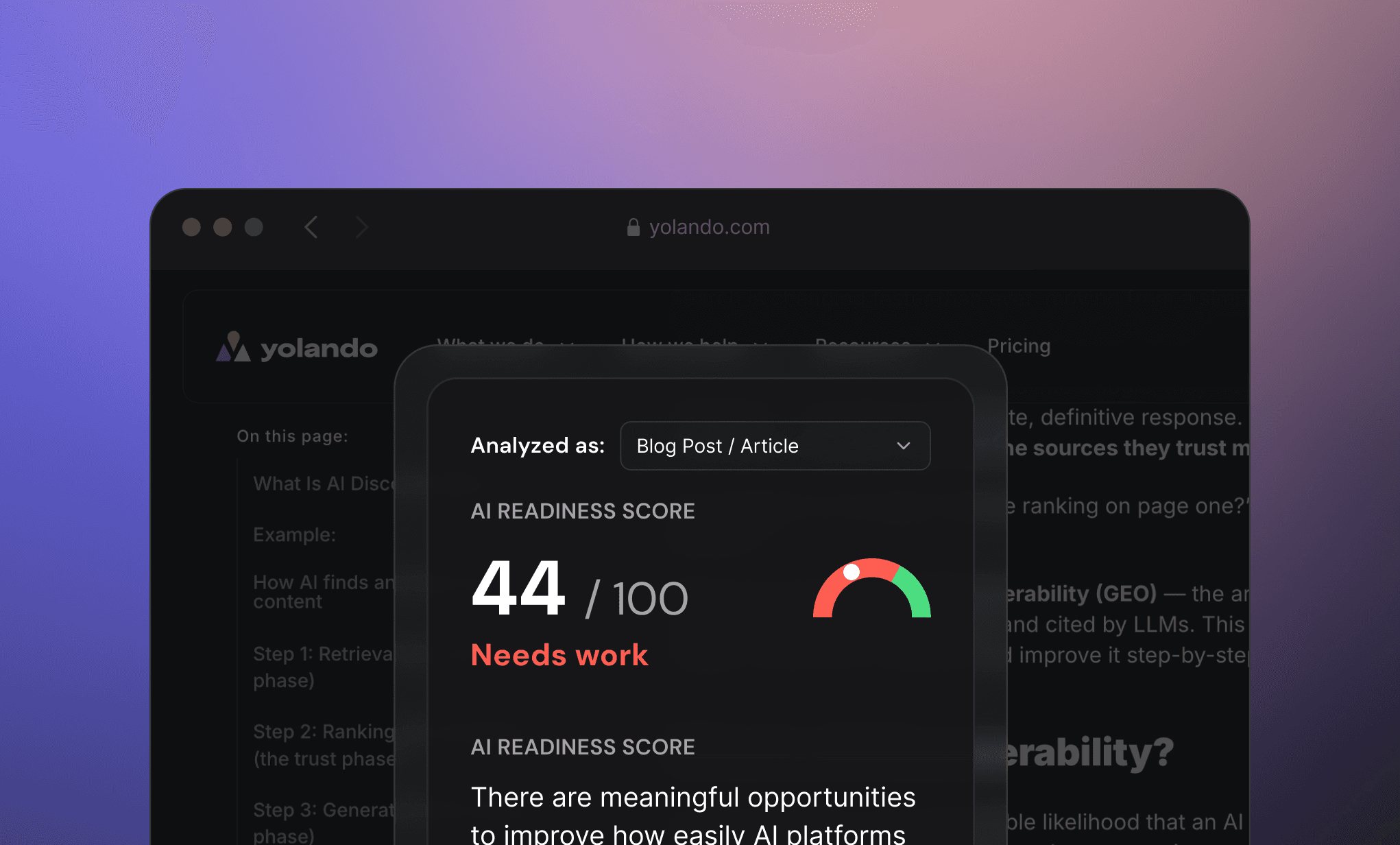
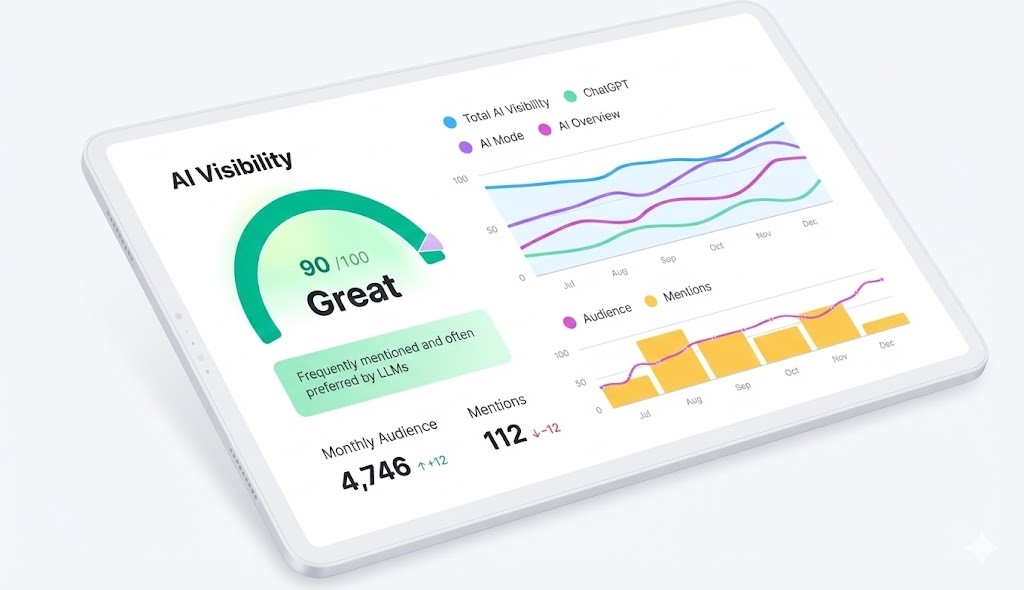
Yolando’s approach transforms existing content into an organized knowledge base (RAG) that AI systems can easily understand and trust, while also tracking how your brand appears in AI answers and identifying who gets cited. [3] That “understand and trust” part is the difference between “AI that guesses” and “AI that stays grounded.”
Rather than the fragments created by LLM’s that don’t really know anything about your brand, Yolando’s content hub generated based on your Brand Voice and what you upload into the Knowledge Base, because grounding the AI in your guidelines, data, and context produces output that stays relevant and true to your brand.
In other words: instead of asking every tool to reinvent your brand voice, you give the system a durable foundation.
A brand memory solves consistency. But teams also need a place to create without bouncing between tools. That’s where Yolando’s Marketing Studio comes in: a unified workspace that turns insight into output.
Yolando’s Marketing Studio automatically transforms insights into high-quality content “in your unique voice” that wins “both hearts and algorithms. For marketers, this is the promise: you don’t just learn what to fix—you can generate the content that fixes it, already grounded in your brand system.
When content creation lives across five separate tools, the workflow breaks in predictable ways:
different prompt styles,
different “defaults” for tone,
different levels of factual grounding,
inconsistent revisions and approvals.
Centralizing creation is less about convenience and more about governance. A single hub makes it easier to ensure:
the same brand voice rules apply everywhere,
the same factual claims are reused consistently,
the same positioning language shows up across channels.
One of the biggest frustrations marketers express is that generic AI output feels interchangeable. Yolando explicitly is designed to avoid “AI slop,” and that grounding in your brand voice + Knowledge Base is what keeps output precise and on-brand.
That’s important because brand voice loss isn’t usually caused by one bad draft. It’s caused by a system that produces thousands of “almost us” sentences—until your brand starts sounding like everyone else.
AI can absolutely help you move faster. But if you’re using a fragmented set of LLM tools without shared memory, you’re also increasing the likelihood of voice drift, message drift, and brand risk—often without noticing until the damage is already public.
The fix is straightforward conceptually: replace “AI tools that guess” with a system grounded in a single, LLM-readable brand memory, and a creation workflow that applies that memory consistently. Yolando’s approach—Knowledge Base + Brand Voice grounding + Marketing Studio—exists to solve exactly that problem: help teams scale content while staying unmistakably on-brand. [2]
If you want AI to be a multiplier for your brand, it can’t be improvising your brand. It needs the same source of truth your best marketers already use—just structured for LLMs.
Magid, “How Brands Can Avoid ‘Surprises’ and ‘Voice Drift’ in the AI Era,” Magid, Oct. 2025. https://magid.com/news-insights/avoid-surprises-and-voice-drift-in-ai/
Yolando, “Yolando | Get Found, Cited, and Recommended by AI,” Yolando, 2025. https://yolando.com/
PromptWire, “Testing the Top GEO Tools: AirOps, Profound, and Yolando Compared,” PromptWire, 2025. https://www.promptwire.co/articles/testing-the-top-geo-tools-airops-profound-and-yolando-compared