AI SEO & Discoverability
Jan 4, 2026
Photo Credit: Yolando
LLMs are now a real marketing channel, not just a novelty. What ChatGPT, Gemini, Claude, and Perplexity say about your brand can influence purchase decisions as much as your website, ads, or reviews.
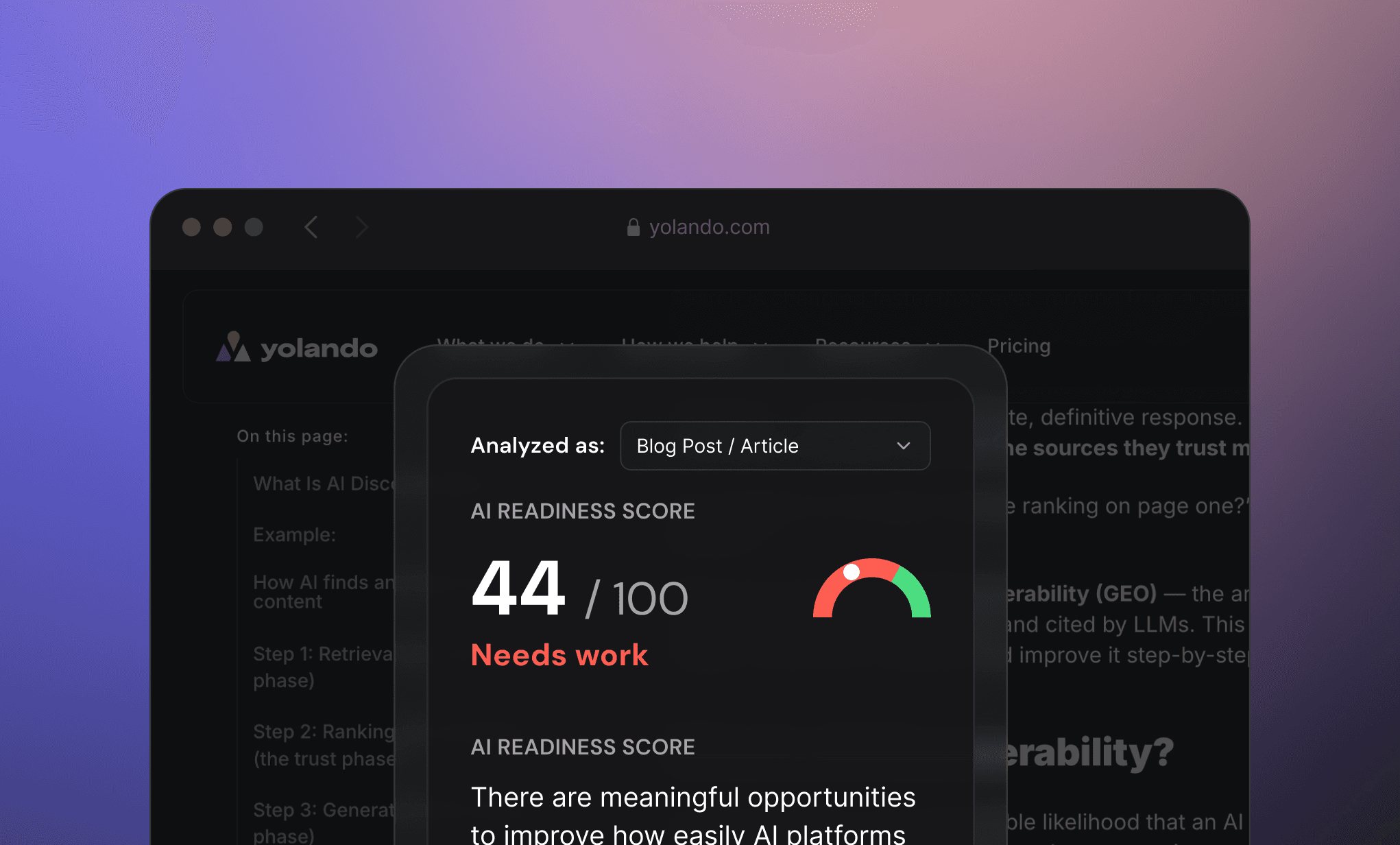
AI visibility platforms make the “AI layer of the internet” measurable. Tools like Yolando track your brand’s presence, share-of-voice, citations, sentiment, and competitive benchmarks across major models so you can see where you show up—and where you don’t.
A structured, machine-readable Knowledge Base is your new brand foundation. By turning scattered assets into a unified, RAG-ready brand memory (facts + voice), Yolando helps LLMs understand, verify, and accurately describe your brand.
Marketing Studio turns insights into GEO content that LLMs love to quote. Yolando links discoverability gaps directly to on-brand, AI-friendly content—making it easier to improve recommendations, control narrative, and win “best X for Y” answer slots.
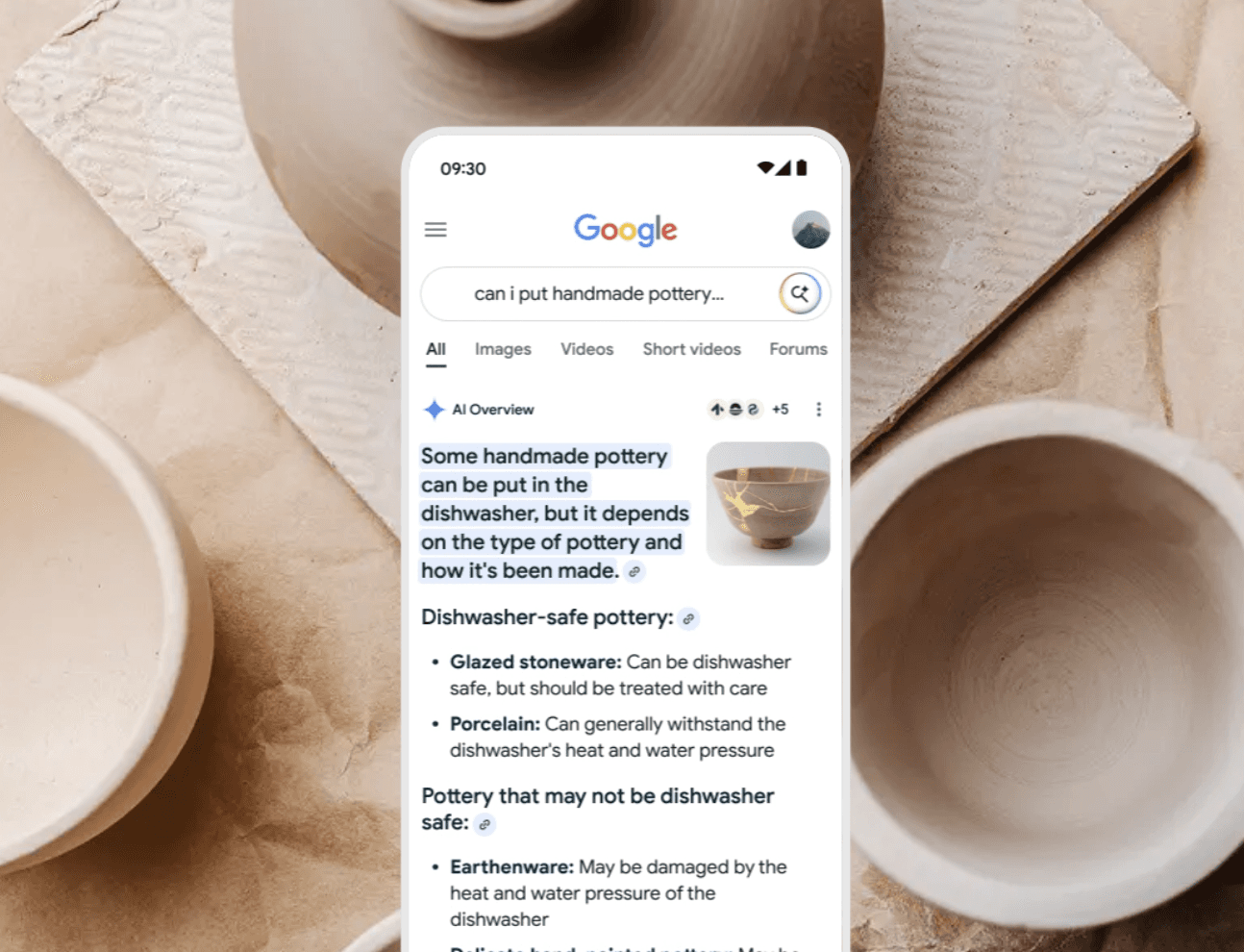
Generative AI is rapidly becoming the new front door to your brand. Instead of typing into search bars and sifting through blue links, customers are asking AI assistants, ChatGPT, Gemini, and Perplexity, or direct product advice, comparisons, and recommendations. In this shift, how large language models (LLMs) perceive your brand, and how they talk about it, can influence buying decisions as strongly as your website or ads ever did.
That’s both exciting and risky. When an AI-generated answer includes your brand as a trusted option, you’re effectively “in the consideration set” before a user even visits a site. But if your brand doesn’t show up, shows up inaccurately, or appears with the wrong positioning, you’re invisible precisely where purchase intent is forming. This is the core problem that AI visibility platforms aim to solve: they help marketers track, understand, and shape what LLMs say about their brand.
To make this concrete, let’s use Yolando as a case study. Yolando lets you see what AI sees, shape what it says, and ensure your brand shows up when it matters. In practice, it functions like an AI-era marketing command center. It learns your brand voice and facts, monitors your presence in AI answers across major models, and produces “generative-engine-optimized” content designed to increase your likelihood of being mentioned and recommended.
Yolando organizes this work into three pillars: AI Discoverability, Knowledge Base, and Marketing Studio. Together they form a full loop: measure → understand → improve.
The first pillar, AI Discoverability, is about listening. Yolando continuously tests how different AI systems mention your brand by running relevant prompts across multiple models—OpenAI’s GPT line, Anthropic’s Claude, Google’s Gemini, Perplexity, and others. Think of it as a persistent audit of what the “AI layer of the internet” currently believes about you.
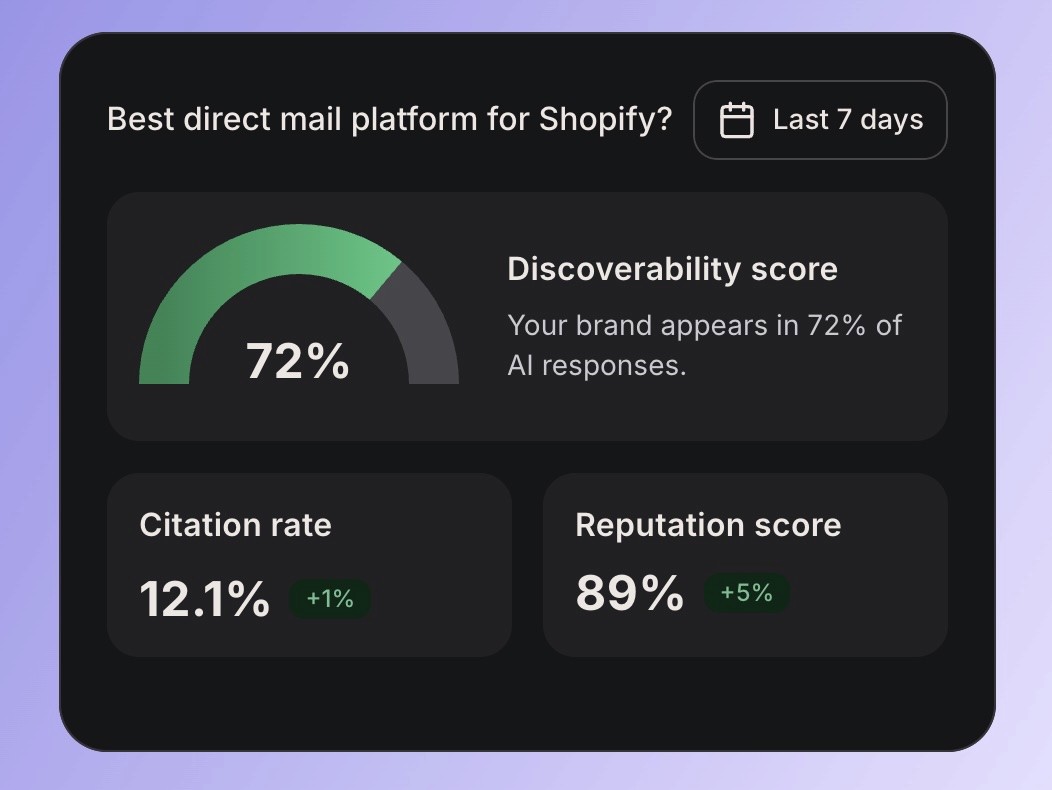
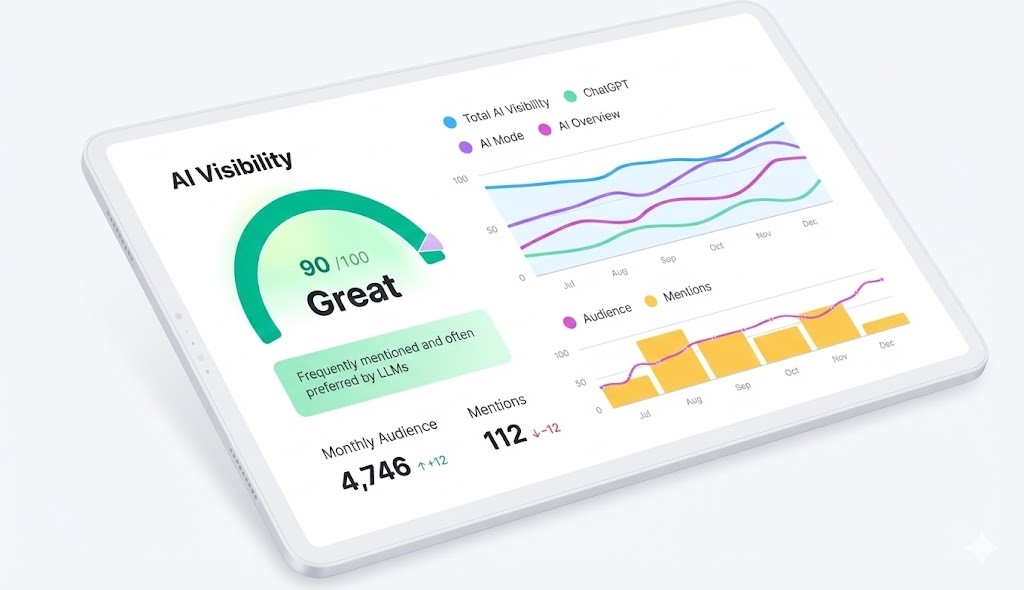
At the center is a visibility dashboard that quantifies how often you appear in AI answers for the topics you care about. Instead of rankings on a traditional search results page, the unit of competition becomes presence in an answer. Yolando measures a discoverability score and share-of-voice relative to competitors.
For example, a brand might learn:
“We appear in 65% of AI answers for ‘best budget CRM for freelancers’.”
“Competitor A appears in 82% for the same prompt cluster.”
This isn’t vanity tracking. It highlights where your AI channel performance is strong and where you’re absent, especially in high-intent comparisons and “best X for Y” queries that drive decisions.
LLMs often justify answers by citing sources (or, in some cases, implicitly leaning on them). Yolando tracks:
when the model mentions your brand by name,
which models do so most reliably, and
which sources those models cite when providing category answers.
This matters because the web pages LLMs cite or rely on are effectively your new “ranking signals.” If AI assistants consistently reference a competitor’s blog, review site, or third-party roundup instead of your own materials, you’ll have a harder time being recommended. Citation tracking exposes where the narrative is coming from so you can strengthen the content that LLMs are actually using.
Being mentioned is only half the battle. The tone of that mention can tilt preference. Yolando analyzes sentiment across AI outputs to estimate a reputation score. If a model says, “Brand X is a decent option, but Brand Y is more reliable,” you want to know that now, not after you notice a dip in pipeline.
Sentiment tracking also catches subtle problems:
outdated information (e.g., old pricing or discontinued features),
repeated misconceptions,
negative comparisons surfacing in certain prompt categories.
These insights give you a concrete list of what needs fixing in the AI narrative.
Yolando lets marketers benchmark discoverability, citations, and sentiment side-by-side with competitors. This is where the platform starts to resemble “SEO tooling for generative answers.” It doesn’t just tell you your share-of-voice; it tells you why competitors are winning.
You might discover:
a rival is cited because they have clearer comparison pages,
another is recommended because AI sees more consistent praise in reviews,
or a new entrant is rising because they’ve published structured, easy-to-quote guides.
Benchmarking removes guesswork and replaces it with evidence.
Bottom line: AI Discoverability turns the invisible world of LLM opinions into measurable marketing terrain. It answers: Where do we show up? How do we compare? What’s missing? What’s changing?
Knowledge Base: Building a Machine-Readable Brand Memory
If AI Discoverability is about listening to models, Knowledge Base is about shaping what models know. Yolando’s Knowledge Base is a structured, machine-readable “memory” of your brand—essentially a private knowledge graph plus retrieval layer built for generative systems.
Brands already have tons of content—web pages, FAQs, spec sheets, reviews, docs, product feeds. The issue is that it’s scattered and inconsistent, and LLMs don’t always interpret it correctly. Yolando ingests your assets and converts them into structured information that models can retrieve reliably.
This involves:
extracting core facts,
normalizing terminology,
linking claims back to sources,
organizing content into coherent topic clusters.
The goal is to make your brand easy for machines to understand and quote.
Yolando relies on a technique now common in enterprise AI: retrieval-augmented generation (RAG). Instead of expecting an LLM to “remember” everything from training, a RAG system retrieves the most relevant verified content at generation time, then uses it to craft accurate answers.
In Yolando’s case, this means your presence in AI outputs becomes less dependent on vague, stale model training and more dependent on up-to-date verified brand knowledge. When an AI system needs to answer a category question, it has a clearer, more citable foundation for recommending you.
Knowledge Base doesn’t only store what you are; it learns how you speak. By analyzing your existing copy and messaging, Yolando models your tone, style, and positioning. This matters because generative answers can drift into generic phrasing or off-brand claims. A unified voice layer helps keep AI outputs aligned with how you want to be described.
Yolando also builds contextual awareness around:
competitor messaging,
category norms,
common customer pain points,
features that matter most in AI comparisons.
This is like continuously updating a SWOT analysis inside the system. If competitors highlight something you don’t, or if the category narrative shifts, Yolando flags the gap so you can respond.
The Knowledge Base is living infrastructure. It updates as you publish new content, ship features, or receive new reviews. This is vital because LLM perceptions are time-sensitive. A static knowledge snapshot from last year won’t keep you visible if the market or your offering changes.
Bottom line: The Knowledge Base is your foundation for AI-era brand truth. It makes your brand readable, verifiable, and recommendation-ready to machines.
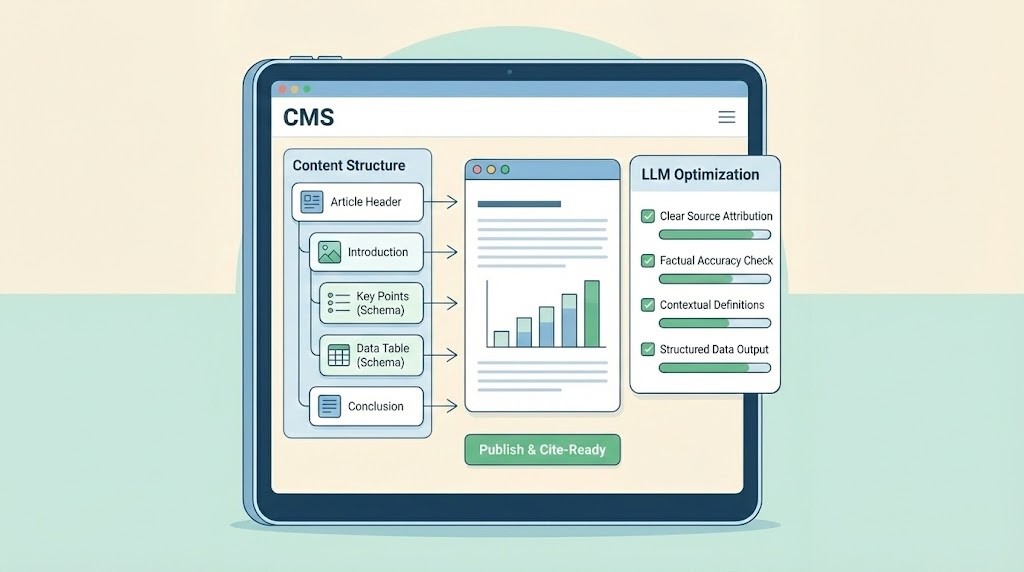
Insight and knowledge don’t matter unless you act on them. Yolando’s third pillar, Marketing Studio, is where the platform turns diagnosis into execution. It helps marketers produce content designed to improve AI visibility, what many now call Generative Engine Optimization (GEO).
Traditional SEO tools might tell you “create a blog post about X” and leave you to do the rest. Yolando links Discoverability gaps directly to content plans and drafts. If it finds that AI users ask “best workflow tool for nonprofits” and you don’t appear, the Marketing Studio can:
recommend a content asset (blog, FAQ, landing page, comparison guide),
generate a draft in your voice,
structure it for AI-friendly quoting.
This compresses the time between “we found a gap” and “we published the fix.”
Because the Knowledge Base includes your voice and guardrails, content generated in Marketing Studio is less likely to sound generic or risky. Prompt templates can be tuned for compliance, accuracy, and brand messaging, especially valuable for regulated industries or high-trust categories.
So you get speed without sacrificing voice or safety.
GEO isn’t just about keywords. It’s about how machines digest information. Marketing Studio emphasizes:
clear headings,
direct answers,
structured comparisons,
FAQ blocker
concise benefit statements,
specific numbers or facts backed by sources.
LLMs tend to quote content that is easy to lift: well-structured, unambiguous, and information-dense. Yolando’s drafting nudges you toward that shape, increasing citation probability.
Since AI Discoverability is always monitoring, Yolando can recommend updates to existing content when competitive dynamics change. If a competitor starts being cited for a prompt you used to own, the system might suggest:
adding new evidence,
improving clarity,
restructuring for better machine extraction.
This keeps your content, and therefore your AI presence, fresh and aligned across channels.
Bottom line: Marketing Studio closes the loop. It’s where AI visibility becomes actionable content that increases recommendations.
We’re entering a world where “being the answer” often matters more than being the top search result. If an AI assistant gives a single recommended solution and your brand isn’t in it, users might never see your traditional SEO work, ads, or social presence. Generative answers are a new high-intent funnel—and they’re winner-take-most.
That’s why AI visibility platforms are emerging so quickly. They represent the next evolution of SEO into Answer Engine Optimization (AEO) or GEO:
Discoverability = rank tracking for answers
Knowledge Base = schema/knowledge graph for LLMs
Marketing Studio = content optimization for generative systems
The key shift is this: AI visibility depends on being readable, citable, and trusted by machines, not just searchable by humans. Platforms like Yolando make that measurable and improvable.
Yolando illustrates how AI visibility platforms help brands navigate the AI-first discovery era. By combining:
AI Discoverability (continuous monitoring of LLM narratives),
Knowledge Base (machine-readable brand memory), and
Marketing Studio (GEO content creation and refresh),
it offers a blueprint for brands that want to actively manage how AI systems represent them.
Generative AI doesn’t have to be a black box deciding your fate. With the right tooling and strategy, it becomes another channel you can optimize, like search, social, or email. And as AI-driven conversations become a default step in consumer research, the brands that show up accurately and confidently in those answers will compound an advantage.
In the age of AI answers, visibility is victory. AI visibility platforms like Yolando are how marketers make sure their brand is seen, cited, and chosen when it counts.
Yolando, “Get Found, Cited, and Recommended by AI,” Yolando.com, n.d. https://yolando.com/